
India will catch up with China's growth at 7 per cent during 2016-17, the World Bank has forecast, saying India's economy has recovered in the wake of the economic reform measures taken by the new Indian government, falling oil prices and lower interest rates.

Indian economy is likely to end this fiscal with over 6 per cent growth backed by industrial recovery and impressive performance of the service sector, according to ICICI Bank chief executive K V Kamath.

For 2021-22, it projected the economy to clock a growth of 10.6 per cent.

'Slowing down of the economy was mainly due to the demonetisation shock...' 'If you cut off the oxygen supply to a patient in the ICU and the patient dies, the patient does not come alive again when you restore the oxygen supply.'

If you plan to send your child to the US five years from now and expect the rupee to depreciate five per cent every year, adding US funds to your portfolio might be a good idea, says Ashley Coutinho.

The economic costs now beginning to show up in the hard numbers are far worse than initial expectations.

The Indian economy rose by 7.9 per cent in the second quarter of this fiscal, belying analysts expectations of 6-6.6 per cent growth for the period.

The repo or short term lending rate remains unchanged at 6.75 per cent and the reverse repo rate at 7.75 per cent.

'It will take some more time because the affordability of these cars have changed drastically.'

IMF, which has also lowered its global economic growth forecast for 2016 and 2017 by a marginal 0.1 per cent to 3.1 and 3.4 per cent respectively, recommended six 'reform priorities' for India

The second-quarter GDP numbers are scheduled to be announced on Friday.
Slowing economy, election-related uncertainty and tighter monetary conditions pose risks for Indian markets and the BSE index, Sensex, is likely to hover around 20,250 by the end of this year.

For 2017-18 and 2018-19, investors are better off focusing on the quality of measures announced in the Budget and outside it rather than on the Budget numbers themselves, says T T Ram Mohan.

The Finance Ministry expects GDP growth to be 8-8.5 per cent in 2015-16.
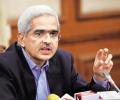
Softening inflation, Das said would make available more policy space to the central bank to address risks to the growth going forward.

International Monetary Fund Chief Economist Gita Gopinath tells Indivjal Dhasmana high-frequency indicators for the third quarter of 2021 indicate momentum in economic recovery in India.

Starting with the third quarter of financial year 2020-21 (Q3FY21), we have seen "unlock" trades at various times. Whenever lockdowns have been eased, traders have taken long positions in consumer-facing businesses. Let's look at the logic. Since March 2020, sectors like retail, personal vehicles, hospitality, aviation, fast-moving consumer goods (FMCG), multiplexes, etc., have been under severe pressure. As a result, there's been a low base effect. Every company in these spaces has suffered top line contraction. Many suffered losses, especially in the first half of FY21.

US's terrible political and economic leadership will ultimately cost the dollar its value. India must act early to avoid being dragged down, suggests R Jagannathan.
The country's economy is expected to grow by around 6 per cent in the current fiscal, even in the worst-case scenario of global recession prevailing till March 2010, according to Arvind Virmani, chief economic adviser in the Ministry of Finance.
The SBI report ruled out a October rate hike

ICICI Bank was the top gainer in the Sensex pack, rising around 3 per cent, followed by Axis Bank, HDFC twins, SBI, L&T, ONGC and Infosys. On the other hand, Sun Pharma, Asian Paints, Nestle India, UltraTech Cement and HUL declined. NSE Nifty rose by 79.60 points or 0.67 per cent to 11,914.20.
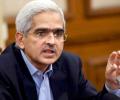
The rising COVID-19 infections across the country are a matter of concern, but it may not impact the ongoing economic revival as one does not foresee lockdowns, Reserve Bank Governor Shaktikanta Das said on Thursday. The economic revival will continue "unabated", Das said, asserting that there is no need for a downward revision of RBI's 10.5 per cent GDP growth forecast for FY22. Speaking at Times Network's India Economic Conclave, Das said, "We have 'insurance' to protect economic revival like a fast-paced vaccination drive, greater ability among people to follow COVID protocols", and one does not see lockdowns as well.

'If you look at the order books of capital equipment companies or money deployed on the ground, there is forward movement in terms of actual investment by the private sector.'

Inflation is on a declining trend, Eco Survey stated.

Stating that India's economic stimulus was not adequate, Banerjee said, the measures did not increase consumption spending of lower income people as the government was not willing to put money in the hands of the low income population.

Other gainers included SBI, Kotak Bank, Sun Pharma, Tata Motors, M&M and Tata Steel, rising up to 5.19 per cent.

Indian economy is doing well and the performance of domestic stock markets is not as bad as that of other nations.

India would be a major beneficiary of softer oil prices among the G20 economies as the country is a major crude importer.

'We all wanted a strong Centre with a decisive mandate from the people, to allow them to take bold decisions.'
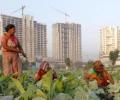
Some experts argue that India's new growth figures are due to the revised calculation of GDP, which was launched in January

Top losers in the Sensex pack included IndusInd Bank, Yes Bank, SBI, L&T, Tata Steel, M&M, Bajaj Finance, Vedanta, Tata Motors and RIL, tumbling up to 6.97 per cent.

Stating that COVID-19 has not yet been contained in India, the rating agency in a statement said the government stimulus package is low relative to countries with similar economic impacts from the pandemic. "The COVID-19 outbreak in India and two months of lockdown -- longer in some areas -- have led to a sudden stop in the economy. That means growth will contract sharply this fiscal year (April 2020 to March 2021)," it said. "Economic activity will face ongoing disruption over the next year as the country transitions to a post-COVID-19 world."

Assocham expressed concern over the precarious situation that the manufacturing sector is in, observing that if the trend does not reverse with monetary and fiscal measures it would be difficult for the industry to generate jobs.

Bank of America (BofA) Securities expects India to be the third-largest economy in the world by 2031. The economic rise could become a reality by 2028, but the Covid pandemic delayed the pace, BofA Securities economists Indranil Sen Gupta and Aastha Gudwani wrote in a report.
Changes in global oil and gas rates matter more to India's economy than other major economies because the country imports around 87 per cent of its oil, half of its gas in the form of LNG, and over 60 per cent of its LPG.

Global funds, according to Christopher Wood, global head of equity strategy at Jefferies, are now beginning to pay more attention to India with the market now offering 30 companies with a market capitalisation over $25 billion.

The cost of not vaccinating the entire population quickly will be far higher than bearing the entire cost of vaccination, points out Prosenjit Datta.

Drop in oil prices and the government's reform agenda has helped India to be out of the Fragile Five group
